
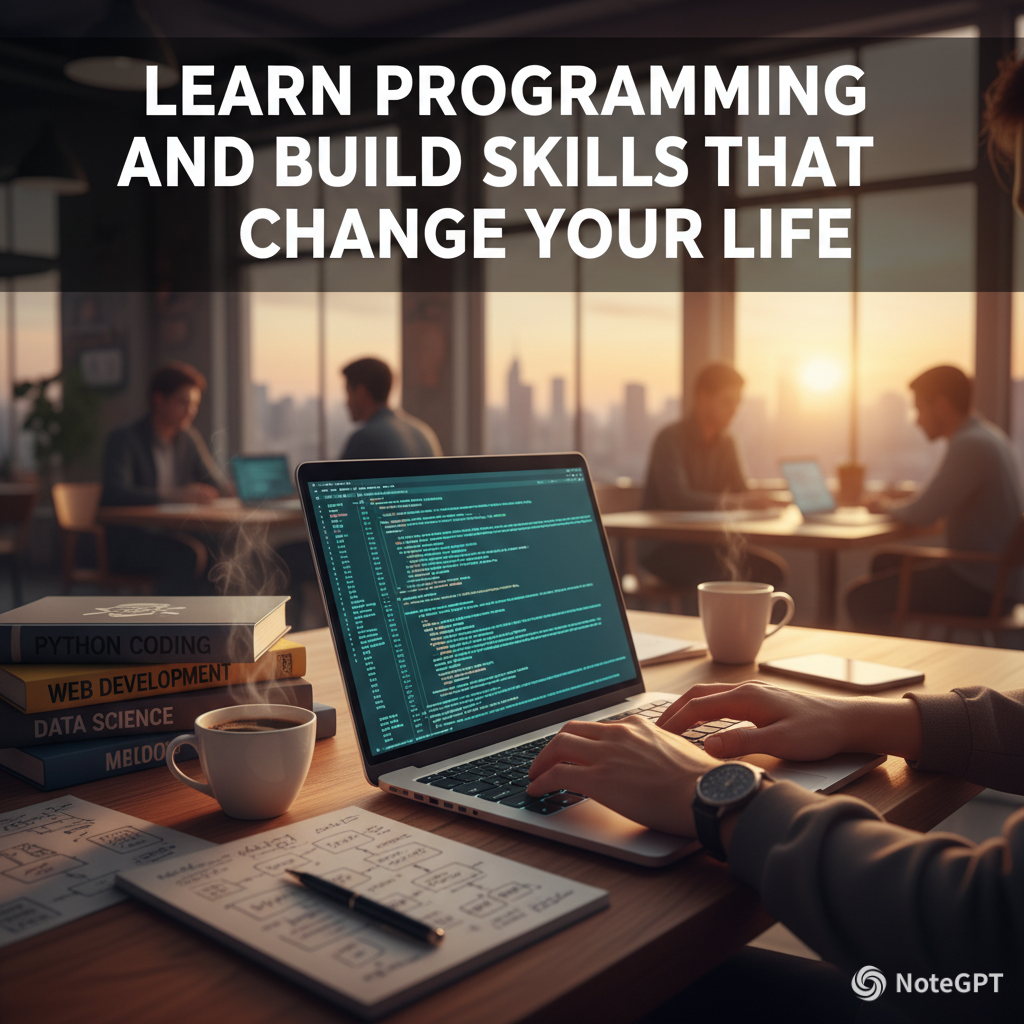
I still remember the first time I wrote a line of code. It was a simple print statement in Python, nothing fancy, nothing groundbreaking. But when that single line of text appeared on my screen exactly as I had told it to, something clicked inside me. That tiny moment of control, of telling a machine what to do and watching it obey, was the beginning of a journey that completely reshaped how I think, work, and solve problems. Programming does that to you. It quietly rewires your brain in the best possible way.
If you are reading this wondering whether coding is something you can actually learn, let me be the first to tell you: yes, you absolutely can. And this article is going to walk you through everything you need to know to get started with confidence.
What Programming Really Means
A lot of people hear the word programming and immediately picture some genius in a dark room surrounded by multiple screens full of cryptic text. That image could not be further from the truth. Computer programming is simply the process of giving a computer a set of instructions to perform a specific task. That is it. You are essentially having a conversation with a machine, just in a language it understands.
Think of it like writing a recipe. When you write down the steps to bake a cake, you are programming a person to follow a process. Programming works the same way, except your audience is a computer, and the language you use follows specific rules called syntax.
Once you strip away the intimidation, programming becomes a deeply logical and even creative skill. And like any skill, it gets easier the more you practice it.
Why Learning Programming Is One of the Best Decisions You Can Make
We are living in a world that runs on software. Every app you use, every website you visit, every smart device in your home exists because someone wrote code to bring it to life. Software development has become one of the most in demand fields on the planet, and that demand is not slowing down anytime soon.
But here is the thing. You do not have to become a full time software engineer to benefit from knowing how to code. Programmers exist in marketing, finance, healthcare, education, and almost every other industry you can think of. Even a basic understanding of programming concepts can make you significantly more valuable in your career.
I have spoken to people at Tekvairo.com who started learning programming purely out of curiosity and ended up changing careers entirely. Others used their new skills to automate repetitive tasks at their current jobs and suddenly found themselves with hours of free time they did not have before. The possibilities are genuinely endless.
Choosing the Right Coding Languages to Start With
This is the question everyone asks first, and honestly it is one of the most important decisions you will make as a beginner. The good news is that there is no single wrong answer. Different coding languages serve different purposes, and the best one for you depends on what you want to build.
Python is widely recommended as the best starting point for beginners. Its syntax is clean, readable, and forgiving, which means you spend less time wrestling with confusing rules and more time actually understanding programming concepts. Python is used in web development, data science, artificial intelligence, and automation, making it incredibly versatile.
JavaScript is another strong choice, especially if you are interested in web development. It is the language of the internet. Almost every interactive element you see on a website, from dropdown menus to live chat features, is powered by JavaScript in some form.
If you are drawn to building mobile apps, Swift for iOS or Kotlin for Android might be your path. For those interested in systems level programming or game development, learning C or C++ opens entirely different doors.
The point is to pick one language, commit to it fully, and resist the urge to jump around. Depth beats breadth when you are starting out.
Understanding the Core Programming Concepts
No matter which language you choose, certain foundational ideas appear across all of them. Variables, loops, functions, and conditionals are the building blocks of virtually every program ever written. Once you genuinely understand these concepts in one language, picking up a second or third becomes dramatically easier.
Algorithm design is another concept that trips people up at first but becomes fascinating once it clicks. An algorithm is simply a step by step process for solving a problem. Every time you use Google Maps to find the fastest route, you are experiencing a sophisticated algorithm at work. Learning to think algorithmically is one of the most transferable skills programming gives you.
Object oriented programming is a style of organizing code that mirrors how we think about the real world. You create objects that have properties and behaviors, just like real things do. A car object might have a color property and a drive behavior. This approach makes large, complex programs much easier to manage and understand.
How to Actually Learn Programming Without Burning Out
Here is something I wish someone had told me early on: consistency beats intensity every single time. Coding for thirty minutes every day will get you further than coding for six hours once a week. Your brain needs repetition and rest to build new mental pathways.
Start with free resources. There are incredible platforms out there that teach programming from absolute zero, and many of them are completely free. The barrier to entry has never been lower. Developer tools and coding environments are also freely available, so there is no financial excuse to delay starting.
Build things as early as possible. Theory is important, but nothing cements learning like actually making something. Even if it is a simple calculator or a basic to-do list app, the process of building forces you to apply what you know and exposes the gaps you need to fill.
Join communities. Programming can feel isolating when you are stuck on a problem that seems impossible to solve. Online forums, local meetups, and platforms like those recommended through Tekvairo.com connect you with developers at all levels who genuinely enjoy helping others grow.
The Journey From Beginner to Confident Developer
I want to be real with you about something. There will be days when nothing works. Days when you stare at an error message for three hours only to realize you missed a single comma. Days when you question whether you are cut out for this at all. Every single developer you admire has been through those exact moments.
The difference between people who succeed and people who quit is not talent. It is persistence. Software engineering rewards people who are willing to sit with discomfort, break problems down, and try again. That mindset, more than any technical skill, is what makes a great programmer.
I remember spending an entire weekend trying to debug a function that was producing the wrong output. When I finally found the issue, it was a logic error in three lines of code. The frustration was real, but so was the satisfaction of fixing it. That cycle of struggle and breakthrough is what makes programming genuinely addictive.
FAQ
What is the easiest programming language for beginners? Python is widely considered the most beginner friendly language due to its simple syntax and broad range of applications across web development, data science, and automation.
How long does it take to learn programming basics? Most beginners can grasp the core fundamentals within two to three months of consistent daily practice, though becoming job ready typically takes six months to a year.
Do I need a computer science degree to become a programmer? No. Many successful developers are self taught. What matters most is your portfolio, your problem solving ability, and your willingness to keep learning.
What is the difference between programming and software engineering? Programming refers to the act of writing code while software engineering is a broader discipline that includes system design, architecture, testing, and project management alongside coding.
Can I learn programming for free? Absolutely. There are numerous high quality free platforms and communities available online that teach programming from beginner to advanced levels without any cost.







Leave a Reply